PLC Programmer Salary 2026 (United States): Ranges by Experience, Role & Industry
PLC Programmer Salary 2026 (United States): Ranges by Experience, Role & Industry
Most salary articles quote one number and move on. That's useless for a role where a fresh PLC technician in rural Alabama earns $45,000 and a senior systems integrator in Houston or New Jersey clears $200,000+ — and both hold the title "PLC programmer."
This article gives you honest US salary ranges for 2026 — broken down by experience level, role type (technician vs. controls engineer vs. SI contractor), and industry (food & beverage vs. pharma vs. oil & gas). We use indicative ranges rather than single "averages" because the spread is real and meaningful. Treat every figure as illustrative: actual pay varies by employer, location, and specialisation. We note uncertainty where it exists.
If you're looking to start earning these numbers, you'll need to be able to write and debug PLC code. Our free PLC training and 40 hands-on scenarios are a zero-cost path to interview-ready.
The Headline Numbers (USD, 2026)
| Role | Entry | Mid (3–7 yrs) | Senior (8+ yrs) | |---|---|---|---| | PLC Technician | $45k–$60k | $60k–$80k | $80k–$110k | | PLC Programmer | $55k–$70k | $75k–$100k | $100k–$135k | | Controls Engineer | $65k–$85k | $90k–$120k | $120k–$160k | | Senior Controls / Principal Engineer | — | — | $140k–$200k | | Systems Integrator (contract) | $75–$110/hr | $110–$180/hr | $180–$300+/hr | | Automation Project Lead | — | $110k–$140k | $140k–$200k+ |
These are indicative US base-salary ranges. The range width reflects real regional and industry variation, not a single "average," and your own number can fall outside it. Bonuses, overtime, and per-diem on field-work assignments can add 10–40% on top for roles that travel.
By Experience Level
Entry-Level PLC Programmer (0–2 years)
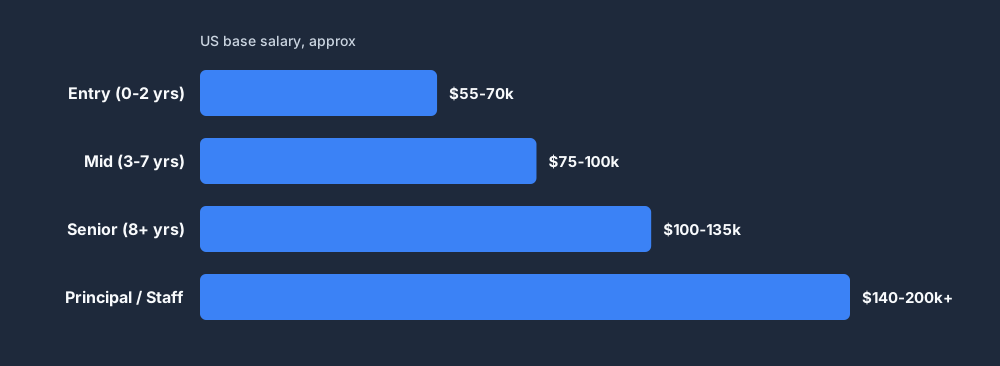
A new PLC programmer in the US typically earns $55,000–$70,000 base in their first role, with slightly lower numbers for pure PLC-technician positions (more maintenance-focused, less programming).
The entry-level spread is driven almost entirely by:
- How you got there. A 4-year electrical engineering graduate starts closer to $70k–$80k. A self-taught technician who moved from maintenance starts closer to $45k–$55k — but compounds faster because they have years of plant-floor experience already.
- Industry. Food & beverage and packaging are cheaper starting points; oil & gas and pharma pay entry-level programmers $75k–$90k.
- Location. A first job in rural Alabama pays ~$45k–$55k. The same role in Houston or Dallas pays $70k–$85k. New Jersey pharma or northern California packaging can hit $85k+.
To land entry-level work you need: fluency in at least one PLC dialect (usually Allen-Bradley in North America, Siemens in Europe), a portfolio you can talk through in an interview, and ideally one industry exposure. Our PLC programming course gets you to that bar free.
Mid-Career (3–7 years)
Mid-career is where the widest spread opens up. The same person with 5 years of PLC experience can earn $75k–$120k depending almost entirely on what they specialized in:
- Maintenance-focused PLC techs tend to cap around $75k–$90k in most of the US. They're valued, but the role has a ceiling because it's primarily reactive.
- Project-focused PLC programmers who write new programs, commission lines, and work with mechanical designers run $90k–$110k.
- Controls engineers — titled differently but with broader responsibility (electrical design, networking, safety integration, HMI) — earn $95k–$120k.
- Integrator / OEM engineers who travel to commission installations for a system integrator firm clear $100k–$140k with per-diem and overtime.
Skills that push you to the top of this range:
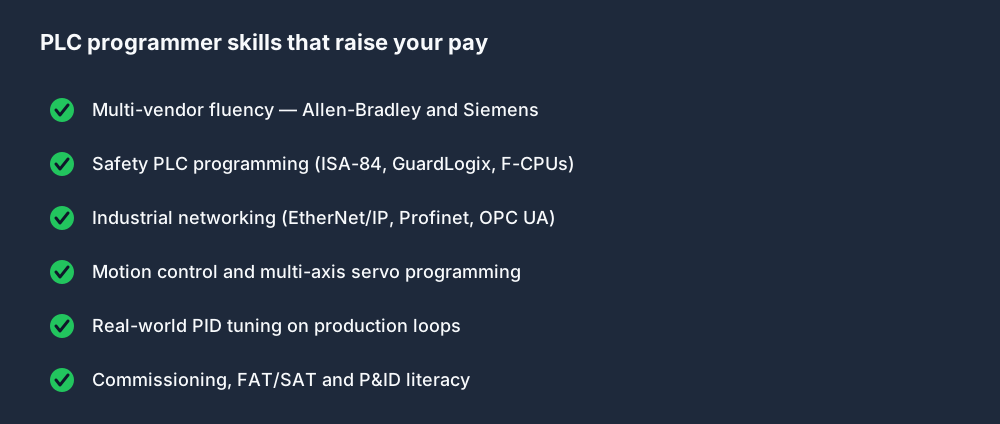
- Safety PLC programming (ISA-84 SIL-rated systems, safety-rated Siemens F-CPUs, Rockwell GuardLogix). Safety PLC fundamentals for background.
- Advanced networking (EtherNet/IP, Profinet, Modbus TCP/IP routing, OPC UA). Read our basic Modbus explainer.
- Multi-vendor fluency (being equally comfortable with AB and Siemens doubles your placement market).
- Motion control (servo programming, Kinetix or Siemens Simotion, coordinated multi-axis).
- PID tuning experience on production loops — not textbook PID. Practical PID guide.
Senior & Principal (8+ years)
At senior level, "PLC programmer" is rarely the job title anymore. People at this level are:
- Senior Controls Engineer ($120k–$160k base) — owns control-system design across a plant or product line. Writes and reviews programs but primary value is architecture.
- Principal / Staff Engineer ($140k–$200k+) — sets standards across multiple plants or business units. Often internal mentor and spec-writer.
- Automation Project Manager / Lead ($140k–$200k+) — runs commissioning projects with $1M–$20M budgets.
- Systems Integrator Partner / Principal — varies wildly; $200k+ base plus equity is common at established integration firms.
Pay at this level correlates more with domain expertise than PLC dialect. A senior who understands pharma batch validation (ISA-88, SAT/FAT processes) or automotive body-in-white controls will clear $180k even in regions where the entry-level role paid $50k.
By Region
United States — PLC Programmer Salary 2026 (Primary Focus)
Already covered above. Regional multipliers vs. US average:
- Texas, Midwest auto corridor (MI, OH, IN): 100–115% of baseline — high demand, cost-of-living moderate.
- Northeast pharma corridor (NJ, PA, MA): 110–130% — pharma pays.
- Pacific NW / CA Bay: 115–135% — but COL adjustment erases most of it.
- South / rural: 85–95% of baseline.
Canada
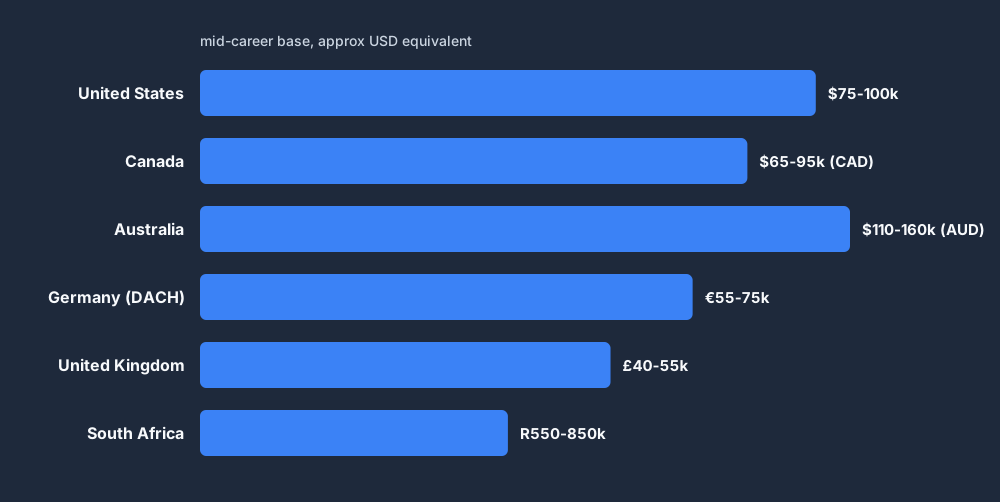
Similar ranges to the US, converted to CAD. Senior controls engineers in Toronto/Vancouver earn CAD $110k–$160k. Entry-level CAD $65k–$80k. Oil sands (Alberta) pays 20–40% over baseline with rotational schedules.
United Kingdom
Smaller salary spread than the US. A PLC programmer with 5 years' experience in the UK typically earns £40,000–£55,000. Controls engineers lead £55,000–£75,000. Senior / principal levels cap around £75,000–£100,000 for in-house, with contract day-rates at £500–£800/day for experienced integrators. Oil & gas (North Sea), aerospace, and pharma pay the top end.
Germany, Austria, Switzerland (DACH)
Siemens-heavy market. PLC programmer (3–7 yrs) typically earns €55,000–€75,000. Senior controls engineers at €75,000–€100,000. Switzerland adds 30–50% on top (CHF, not EUR). TIA Portal / SCL fluency expected — our Siemens PLC training bridges this if you're coming from an AB background.
Nordics / Netherlands / France
Similar DACH ranges, sometimes slightly lower in France and slightly higher in Norway. Dutch controls engineers at medium-sized integrators typically earn €60,000–€85,000.
South Africa
A different structure — narrower spread, but integrator work pays well relative to local cost of living. Entry-level PLC programmers earn R300,000–R480,000/year. Mid-career (5+ years) R550,000–R850,000. Senior controls engineers at mining/petrochem R900,000–R1.4M. Contract integrators on commissioning projects earn considerably more, often paid in USD or EUR by international clients.
Middle East (UAE, Saudi Arabia, Qatar)
Controls engineers on oil & gas or infrastructure projects: USD $8,000–$18,000/month tax-free, often with housing and transport allowances. This is heavily project-based — contracts end and you move. Requires specific industry certifications (often IEC 61508 functional safety, specific vendor certifications).
Australia
Controls engineers earn AUD $110,000–$160,000 with 3–7 years. Mining and energy sectors pay senior roles AUD $180,000–$240,000 with FIFO schedules.
India, SE Asia
PLC programmer salaries in India have risen significantly in the last 5 years but remain well below Western markets. Experienced (5+ years) PLC programmers at domestic integrators earn ₹8–15 lakh/year. At multinational captive centers, ₹15–30 lakh/year. Singapore / KL pay at multinational plants is closer to Australia.
By Industry
Industry matters almost as much as experience.
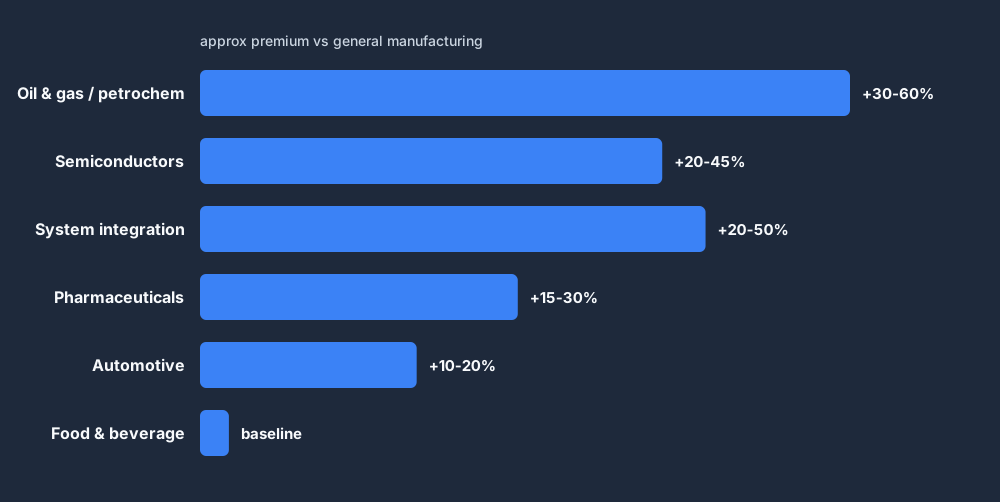
| Industry | Pay vs baseline | Why | |---|---|---| | Oil & gas / petrochem | +30% to +60% | Downtime cost, remote sites, safety regulation | | Pharmaceuticals | +15% to +30% | Validation overhead, ISA-88 expertise, FDA compliance | | Semiconductors | +20% to +45% | Cleanroom, high-throughput coordination, tight tolerances | | Automotive | +10% to +20% | Large programs, robotics integration, IATF 16949 | | Aerospace | +15% to +25% | Certification rigor, AS9100 overhead | | Food & beverage | baseline | High volume of roles, lower margins | | Packaging / converting | −5% to +5% | Broad market, lots of entry-level roles | | Water & wastewater | −10% to +10% | Municipal pay scales, union structures | | General manufacturing | baseline | | | System integration (contract) | +20% to +50% | Higher risk, travel, per-diem |
Specializing in a high-paying industry early (pharma, oil & gas, semi) pays more than broad experience across low-paying industries.
By Role Type
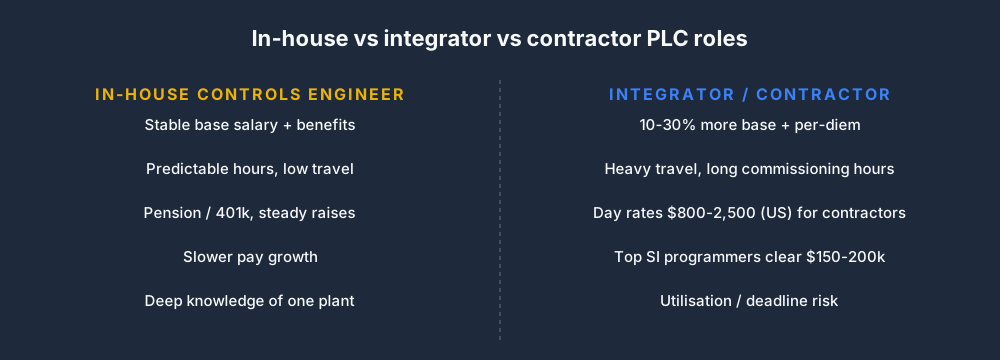
In-house PLC programmer / controls engineer
Stable salary, benefits, pension/401k, predictable hours (mostly). The numbers above apply directly.
Systems integrator (SI) / OEM controls engineer
Often 10–30% more base than in-house, plus overtime, plus per-diem on travel. Downside: constant deadlines, travel weeks on end, brutal commissioning hours. Experienced SI programmers can clear $150k–$200k in the US or €100,000+ in Germany without being at principal level.
Independent consultant / contract programmer
Day rates of $800–$2,500/day in the US, £400–£900/day in the UK, €500–€1,200/day in Germany. Utilisation is the risk. Established independent PLC programmers with a specialty (pharma batch, automotive safety, motion control) bill 180+ days/year and clear $200k+ in the US.
Academic / training / R&D
Lower pay but stable schedules. PLC training instructors at community colleges and technical schools in the US earn $55k–$85k. Corporate training positions at Rockwell, Siemens, or major integrators pay $90k–$130k.
How to Command the Top of Your Range
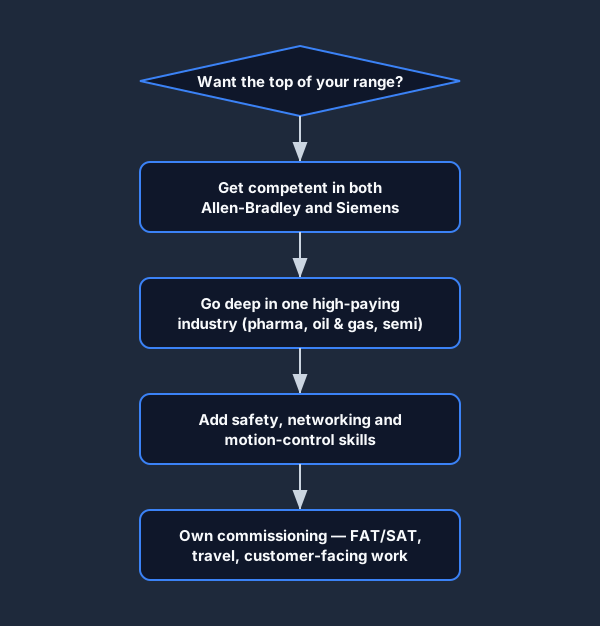
Five things that reliably move people up:
- Multi-vendor fluency. Being competent in both Allen-Bradley and Siemens (not expert — competent) opens 60–70% of postings instead of 30–35%. Study both via our platform.
- One deep industry. Pharma, oil & gas, semi, automotive safety. Pick one and go deep over 3–4 years before jumping.
- Safety programming experience. ISA-84 SIL-rated systems are a durable premium.
- Networking and data skills. EtherNet/IP, OPC UA, MQTT, historians, IIoT integrations. The line between "PLC programmer" and "automation engineer" is mostly here.
- Commissioning and customer-facing experience. Reading P&IDs, doing FAT/SAT, presenting to plant managers. Programmers who can travel to a site and take ownership of commissioning outearn pure desk programmers by 20–40%.
Salary Trajectory Over a Career
A rough, indicative path — typical of the career traces you'll see, not a guaranteed curve:
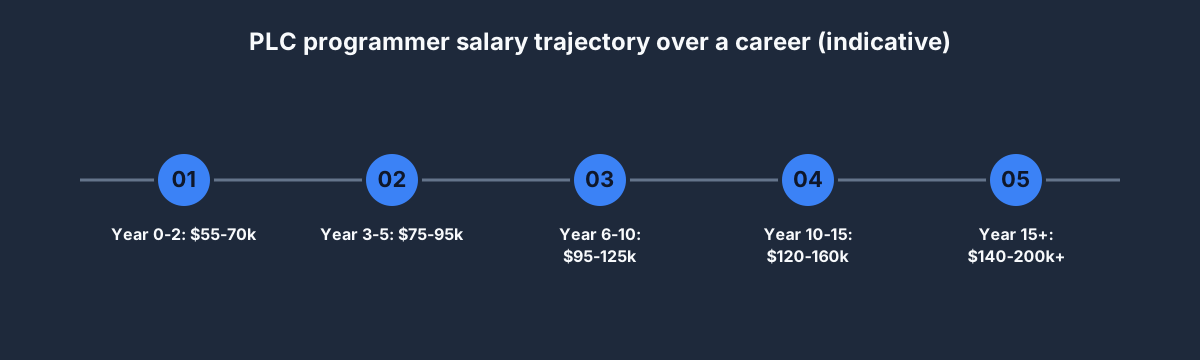
- Year 0–2: $55k–$70k. Learning vendor dialect, reading other people's code, owning small changes.
- Year 3–5: $75k–$95k. Writing new programs end-to-end, owning modules of larger projects.
- Year 6–10: $95k–$125k. Technical lead on projects, sometimes supervising 2–3 others.
- Year 10–15: $120k–$160k. Senior / principal engineer, setting standards or owning a plant.
- Year 15+: $140k–$200k+ (or $200k–$500k in staff/principal roles at large multinationals or via contract work).
Compare to software developer salary curves and PLC programmers trail behind until about year 10, then close the gap — the hardware/field experience accumulated compounds in ways pure-software work doesn't.
Starting From Zero
If you're reading this article to decide whether PLC programming is worth pursuing, here's the honest read:
- It pays less than pure software in the early years.
- It's far more resilient to automation/outsourcing pressure because the physical plant doesn't move offshore.
- The career ceiling is comparable to software once you're 10+ years in.
- Self-teaching works — here's the roadmap.
The fastest path from zero to interview-ready is structured practice on real scenarios. Our free PLC simulator and PLC programming course are a zero-cost way to build a portfolio before you apply for your first role.
FAQs
What is the average salary of a PLC programmer?
"Average" is misleading. In the US, entry-level PLC programmers earn $55k–$70k; mid-career $75k–$100k; senior $100k–$135k. Controls engineers earn 15–25% more than PLC programmers at the same experience level.
Do PLC programmers earn more than software developers?
Usually less in years 1–5. Comparable at 5–10 years. Often higher ceiling for senior SI / integrator work because of travel premiums and scarce specializations.
What's the salary difference between AB and Siemens?
Not much. Region matters more than dialect. In North America, AB-heavy industries (food, automotive, pharma) pay slightly better; in Europe, Siemens-heavy industries do. Being comfortable with both is the real premium.
Is a certification needed to reach these numbers?
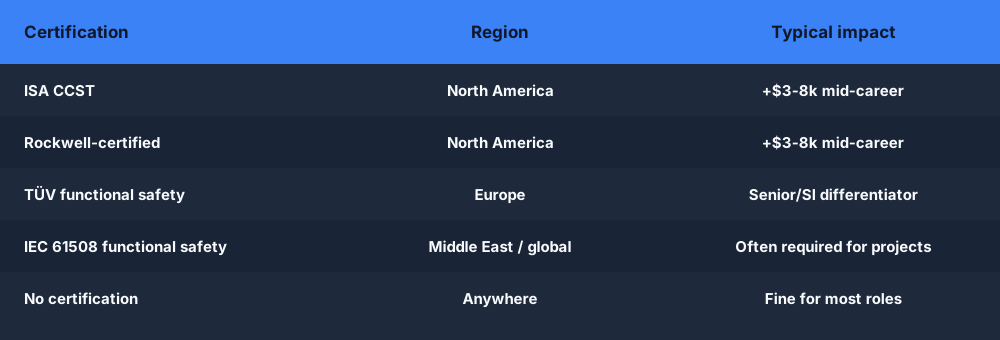
No, but helpful at senior/SI levels. Full certification guide. An ISA CCST or Rockwell-certified credential adds ~$3k–$8k to mid-career earnings in the US; in Europe TÜV functional-safety credentials are the comparable differentiator.
What's the salary for PLC technicians vs engineers?
PLC technicians typically earn 15–30% less than PLC programmers at the same experience level. The gap grows at senior levels because engineer roles scale in responsibility (architecture, project leadership) more than technician roles do.
How fast do PLC programmer salaries grow?
Steady 3–8%/year in-house. Jumping to a new employer every 3–4 years typically produces 15–25% bumps. Senior engineers who specialize (pharma, semi, safety) can double salary over 5 years by moving into the top of their specialty.
What does a system integrator pay?
SI firms pay 10–30% more base than in-house plus per-diem ($80–$200/day) on field work. Travel-heavy role. Top integrator programmers in the US earn $150k–$200k; in Germany €100k+; in Middle East contracts $15,000–$20,000/month tax-free.
Is PLC programming worth pursuing in 2026?
For people who enjoy tangible industrial work, yes — the salary trajectory is strong, the role is resilient to outsourcing, and the demand from reshoring + electrification + pharma growth continues to outpace supply. If you'd rather sit at a desk and never leave it, pure-software pays better and is more comfortable.
Ready to build the skills that unlock these numbers? Start with our free PLC simulator, work through the 40 hands-on scenarios, and follow the self-teaching roadmap. Zero cost, real code, portfolio output.