A free, browser-based RobotStudio alternative for learning robot programming
RobotStudio is ABB’s official offline-programming and simulation software — the professional tool for ABB robots. If you are still learning, you do not need a licensed desktop install to begin. Practise the universal fundamentals — frames, the tool centre point, joint vs linear motion, I/O, pick-and-place, payload, and safety — hands-on in a free browser simulator, then move to brand-specific tools like RobotStudio with confidence.
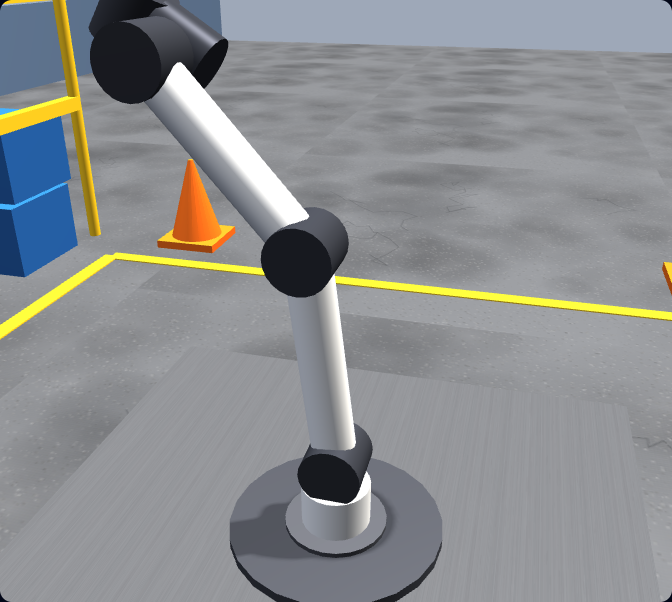
Honest note: this is not an ABB virtual controller and it does not run RAPID. It teaches transferable robot-programming fundamentals using real URScript on a UR-style arm, free to start.
First, fairly
What RobotStudio actually is
RobotStudio is ABB’s official offline-programming and simulation suite for ABB robots. It runs on Windows, builds a 3D model of your robot and work cell, and lets you write and test programs against a virtual controller — software that mirrors the behaviour of the real ABB controller, which is why its simulation is very accurate. That accuracy is the point: integrators use RobotStudio to validate reach, cycle time, and program logic before committing to real hardware.
RAPID, ABB’s robot language
ABB robots are programmed in RAPID. RobotStudio is where you write, edit, and test RAPID programs offline, so the language and the tool are tightly coupled to ABB’s ecosystem.
The virtual controller
RobotStudio runs a virtual controller — the same control software as the real robot — so simulated behaviour closely matches the physical machine. This is the heart of its accuracy and why it is the professional choice for ABB offline programming.
Offline programming & cell design
Model the cell, plan paths, check reach and collisions, estimate cycle time, and commission with confidence — all before the line is built. It is a serious production tool, and a free browser trainer is not a substitute for it.
In short: if you are doing real ABB offline programming, RobotStudio is the right tool and we would point you to it. This page is for the step before that — learning the fundamentals.
Who should use which
Different tools for different jobs
These are not really competitors — they solve different problems. The honest way to choose is to ask what you are trying to do right now.
Use RobotStudio if…
- • You are programming real ABB robots and need accurate offline programming.
- • You need RAPID, a virtual controller, reach and cycle-time validation, or full cell design.
- • You are an integrator or technician committed to ABB hardware.
- • Brand-accurate simulation matters more than running in a browser.
Use our simulator if…
- • You are learning robot programming and want to start in minutes, free.
- • You want zero install — it runs in a browser tab, even on a Chromebook.
- • You want guided, auto-graded lessons and a certificate, not just a sandbox.
- • You are not yet committed to one brand and want transferable fundamentals first.
Fair comparison
RobotStudio vs our browser simulator
A side-by-side on the things that actually differ. Neither column is “better” in the abstract — they are built for different stages.
| ABB RobotStudio | Our simulator | |
|---|---|---|
| Runs | Windows desktop install | In the browser, no install |
| Cost to start | Free trial / limited tier; full suite licensed | Free to start; Pro for course + certificate |
| Primary purpose | ABB production offline programming & simulation | Learning robot-programming fundamentals |
| Robot scope | ABB robots (RAPID, virtual controller) | Brand-neutral fundamentals on a UR-style arm |
| Language | RAPID | Real URScript |
| Simulation accuracy | Very high — mirrors the real controller | Physics-based trainer, not a virtual controller |
| Structure | Open-ended professional environment | Guided, auto-graded lessons + certificate |
Note: our simulator is not an ABB virtual controller and does not run RAPID. It teaches the transferable concepts that make RobotStudio — and any brand-specific tool — easier to learn.
In the simulator
The fundamentals that carry to ABB and beyond
You do not just watch — you write real robot code, run it on a simulated six-axis arm under physics, and get graded against a real goal. Every skill here is one that ABB, FANUC, KUKA, and Universal Robots programmers all rely on.
Frames & coordinate systems
World, base, and tool frames decide where the robot thinks it is — the same idea ABB calls work objects and tool data.
Tool Centre Point (TCP)
Define the working point of your gripper or tool so the robot moves the right spot to the right place.
Joint vs linear motion
When fast joint moves are right and when a straight Cartesian line matters — core to every brand, RAPID included.
Waypoints & sequencing
Approach, act, retract: chaining points into a smooth, safe path is the same skill on any controller.
Digital I/O & grippers
Read inputs and set outputs to drive a gripper or signal a PLC — universal; only the syntax changes.
Payload & collision safety
Configure payload, respect reach, and avoid collisions and over-force contact — the heart of safe robot work.
Our honest recommendation
Learn first, specialise second
If you are an ABB integrator with hardware in front of you, use RobotStudio — it is the professional, brand-accurate tool and we are not pretending to replace it. But if you are new to robot programming, jumping straight into a licensed desktop suite means spending your energy fighting the install and the interface instead of learning to think like a robot programmer.
The faster path is to build the fundamentals where they are free and frictionless — in the browser, with real robot code and graded feedback — and then layer ABB’s RAPID and RobotStudio on top. When you reach RobotStudio, you will be learning a new language and a new interface, not the entire mental model from scratch.
Keep exploring
More robot programming resources
- Robot programming course — the full graded path from first jog to a working pick-and-place cell.
- ABB robot programming — how the fundamentals map to ABB’s RAPID and RobotStudio.
- Robot arm simulator — practise six-axis arm motion and kinematics in the browser.
- Universal Robots programming — learn URScript and the UR workflow our simulator is built around.
- Robot simulator — the home of our browser-based robot programming trainer.
RobotStudio alternative FAQ
Start learning robot programming in your browser.
Write real robot code — frames, TCP, motion, I/O, pick-and-place, and safety. No install, no licence, free to start. Then take those fundamentals to RobotStudio and ABB RAPID.