How to Pass the ISA CCST Exam: A 30-Day Study Plan
How to Pass the ISA CCST Exam: A 30-Day Study Plan
The ISA Certified Control Systems Technician (CCST) certification is one of the most respected credentials in industrial automation. It is vendor-neutral — unlike manufacturer-specific certifications from Rockwell, Siemens, or Mitsubishi — which means it is recognised regardless of which brand of PLC your employer runs.
This guide is a practical 30-day study plan for candidates who are working while studying. It is realistic rather than optimistic. If you have never worked with PLCs before, give yourself 60–90 days, not 30.
Disclosure: This study plan covers the CCST Level I exam (Instrumentation and Control). The PLC simulator covers the automation and control systems topics but is not an official ISA preparation tool and does not replicate ISA exam questions. The practice you get here is representative of the type of thinking the exam requires.
What the CCST Exam Tests
The ISA CCST Level I exam covers:
- Measurement — pressure, level, temperature, flow, analytical measurements
- Control systems — PLC basics, DCS basics, control loops, PID tuning
- Troubleshooting — loop troubleshooting, signal tracing, instrument maintenance
- Calibration — instrument calibration, loop calibration, error calculation
- Safety — SIS basics, hazardous area classification
The exam is 110 multiple-choice questions over 3 hours. Passing score is typically 70%.
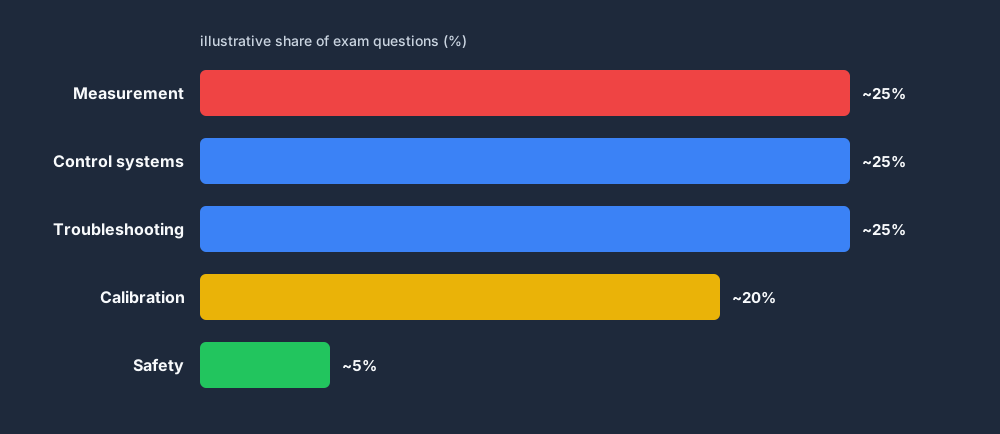
The five domains and the kind of topics under each are summarised below — the weightings shown are illustrative planning estimates, not official ISA figures.
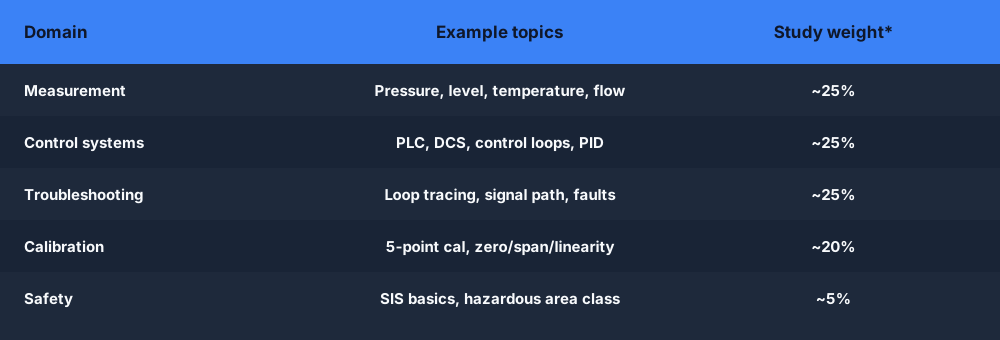
The PLC and control loop content (20–25% of the exam) is where a simulator can meaningfully help. The calibration and measurement theory requires textbook study.
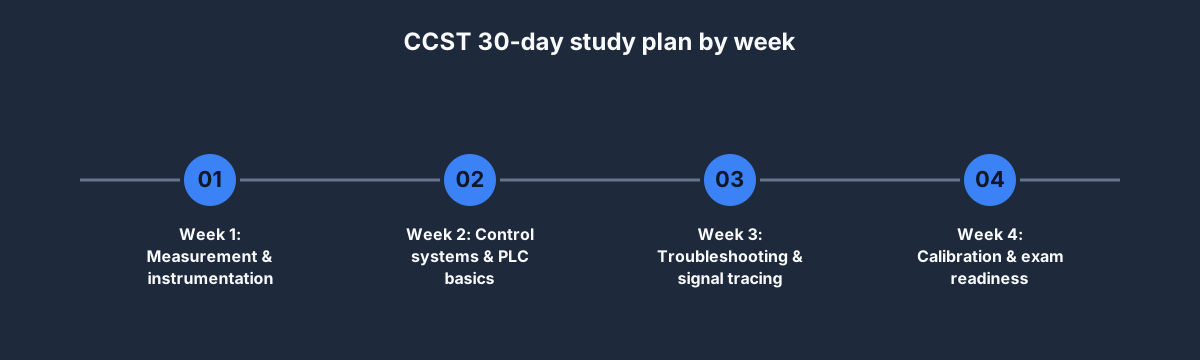
30-Day Study Plan
The plan splits into four themed weeks, each building on the last before exam readiness.
Week 1: Measurement and Instrumentation Foundations (Days 1–7)
Days 1–2: Pressure measurement
- Gauge, absolute, differential, vacuum pressure
- Bourdon tube, capacitive, piezoelectric transmitters
- 4–20 mA current loop wiring and failure modes
Days 3–4: Level measurement
- Differential pressure method (DP cells)
- Float, ultrasonic, guided wave radar
- Bubbler systems
Days 5–6: Temperature measurement
- Thermocouple types (J, K, T, E), cold junction compensation
- RTD (Pt100, Pt1000), 2-wire vs 3-wire vs 4-wire
- Pyrometers
Day 7: Flow measurement
- Orifice plate, venturi, Coriolis, magnetic, ultrasonic
- Bernoulli equation basics
- Practice: Complete the Analog I/O lesson in the curriculum — covers 4–20 mA scaling, which appears directly on the exam.
Week 2: Control Systems and PLC Basics (Days 8–14)
Days 8–9: PLC fundamentals
- CPU, I/O modules, power supply, backplane
- Input and output card types
- Scan cycle (essential — re-read The PLC Scan Cycle Explained)
- Practice: Complete PLC Fundamentals (Lesson 1) and Ladder Logic Basics (Lesson 2) in the simulator
Days 10–11: Ladder logic programming
- Contacts, coils, timers, counters, comparators
- Seal-in rungs, latching coils, edge detection
- Practice: Complete Lessons 3 and 4 (Timers & Counters, Seal-in Rungs) in the simulator
Days 12–13: PID control theory
- Proportional, integral, derivative explained
- Process gain, integral time, derivative time
- Open-loop vs closed-loop
- Practice: The PID Control lesson in the curriculum covers practical PID tuning
Day 14: DCS vs PLC
- When each system is used
- Safety instrumented systems (SIS) basics
- Fieldbus protocols: HART, Foundation Fieldbus, Profibus
Week 3: Troubleshooting and Signal Tracing (Days 15–21)
Days 15–17: Loop troubleshooting methodology
- Split-range troubleshooting (isolate the signal path)
- Checking 4–20 mA loops with a HART communicator
- Milliamp source/sink testing
Days 18–19: PLC fault-finding
- Input not responding: field device fault vs wiring fault vs PLC fault
- Output not responding: same diagnostic tree
- Using force mode (with caution)
- Practice: The fault injection module in the simulator — diagnose 3 injected wiring faults. See the fault diagnosis page.
Days 20–21: Alarm management basics
- Alarm priority levels (ISA 18.2)
- Deadbanding and alarm suppression
- Trip testing
Week 4: Calibration + Exam Readiness (Days 22–28)
Days 22–24: Calibration fundamentals
- As-found / as-left documentation
- Five-point calibration (0%, 25%, 50%, 75%, 100%)
- Error types: zero error, span error, linearity error
- Calibration interval concepts
Days 25–26: Hazardous area classification
- Zone 0, 1, 2 (IEC) vs Division 1, 2 (NEC/NFPA 70)
- Intrinsic safety, flameproof, increased safety concepts
Days 27–28: Full practice exam + review
- ISA sells official CCST practice exams. Take one in a timed 3-hour block.
- Review every incorrect answer against your study notes.
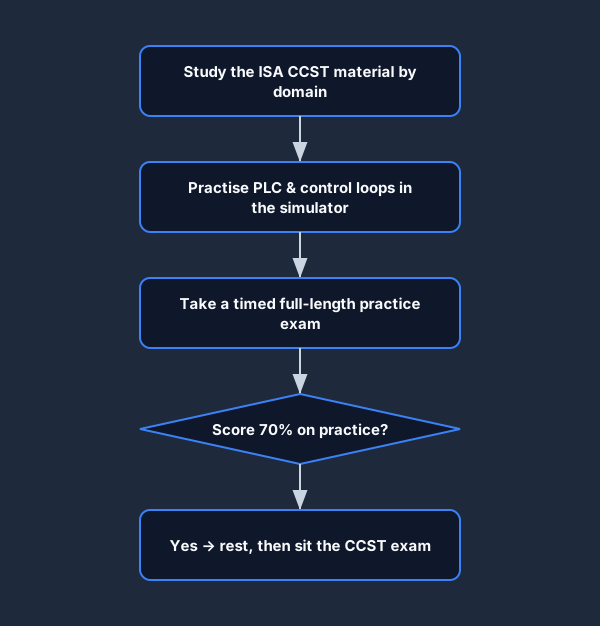
The overall arc — study, practise in a simulator, then prove readiness on a timed mock — looks like this:
Days 29–30: Rest and consolidation
Take at least one full day off before the exam. Review your weak areas in the morning before the exam, then stop. Fatigue impairs recall; rest improves it.
Key Resources
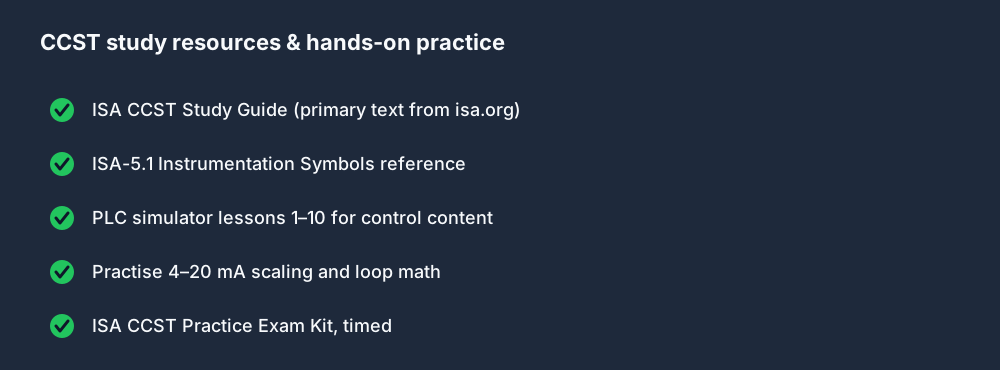
- Primary: ISA's own CCST Study Guide (purchase from isa.org)
- Supplementary: ISA-5.1 Instrumentation Symbols and Identification (free PDF preview)
- Simulator: PLC Simulation Software for the hands-on PLC and control loop practice
- Practice exam: ISA CCST Practice Exam Kit (sold separately on isa.org)
Common Reasons Candidates Fail
-
Underestimating measurement theory — many candidates from a PLC background skip the instrumentation fundamentals. The exam is split roughly equally between measurement, control, troubleshooting, and calibration. Skipping measurement theory means starting with a 25% disadvantage.
-
Confusing PLC scan cycle concepts — questions about what happens when an input changes mid-scan, or whether a coil set on rung 20 is visible to a contact on rung 5 in the same scan, trip up many candidates. This is covered extensively in the scan cycle guide.
-
Weak 4–20 mA arithmetic — expect 5–10 questions asking you to calculate output current for a given process variable, scale a 4–20 mA signal to engineering units, or identify a fault from the milliamp reading.
-
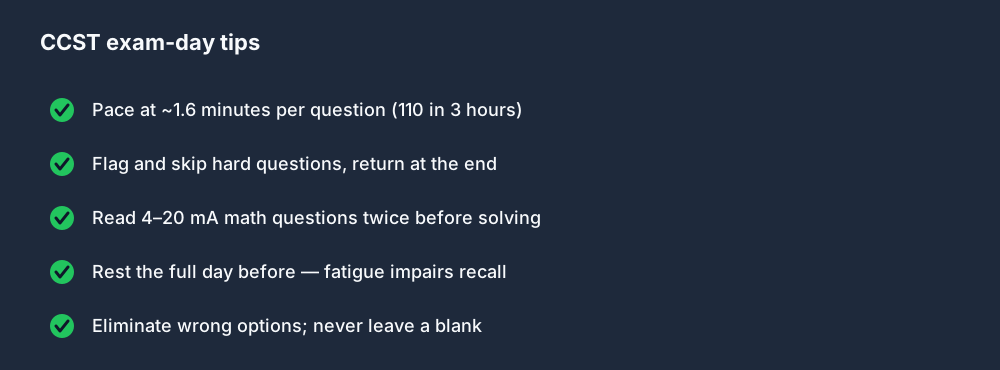
Not practising under timed conditions — 3 hours for 110 questions is 1.6 minutes per question. If you have never practised under time pressure, the exam feels faster than you expect.
Keep these exam-day habits in mind to protect your pacing and score:
Practise the PLC and control loop sections in the simulator. Lessons 1–10 of the curriculum cover exactly the PLC content tested on the CCST exam — with live exercises, not passive reading.